Janet McKenzie
(b. 1949)
With its steepled, white clapboard First Congregational Church, historic Grand Trunk railway station, blazing autumns and snow-blanketed winters, Island Pond, Vermont, (pop. 750) is the kind of rural New England town you would associate more with Currier and Ives prints than cutting-edge contemporary art. Ever since Brooklyn-born Artist Janet McKenzie left New York City in 1995 to settle in this Northeast Kingdom community, her studio in a vintage salmon-colored house has become the epicenter of a quiet revolution aimed at nothing less than overturning the millennia-long white patriarchal focus of Christian art. She paints Asian Madonnas with origami cranes, a Native American Holy Family in hand-woven blankets, Mary Magdelene as a woman of color, and gender-bending images of Jesus.
McKenzie first sent shockwaves through the convention-bound sacred art scene, when she won a 1999 competition to find a new image of Jesus at the Millenium, sponsored by the National Catholic Reporter journal. Her depiction of Jesus of the People as a person of color, modelled on a woman of color, was selected out of 1700 entries from around the world. As the presiding judge, Sister Wendy Becket of BBC art documentary fame, explained her choice: “This is a haunting image of a peasant Jesus, dark, thick-lipped, looking out on us with ineffable dignity, with sadness but with confidence. Over His white robe He draws the darkness of our lack of love, holding it to Himself, prepared to transform all sorrows if we will let Him.”
When McKenzie’s pioneering portrait was given a public viewing on the Today Show, angry Christian conservates immediately barraged her with hate messages, threatening McKenzie with hell-fire—and much worse—for daring to challenge the masculinity of Christ. Only a providential blizzard prevented enraged traditionalists from picketing her home. The artist’s inclusive Jesus has stood the test of time, becoming an object of reverence for viewers as it travels to North American sacred art venues. It appears on posters in demonstrations across the U.S. against social injustice. Says McKenzie: “My painting does not replace interpretations of Jesus that have come before; it is a new version that includes two groups that have traditionally been left out of the physicality of Christ — people of color and women. The painting came from a place of love.”
The notion of becoming a sacred art collector was just taking shape in my mind, when I first encountered a feminist Crucifixion scene by McKenzie on a visit in 2007 to a religious art gallery in Taos, New Mexico. I purchased Ghost Ranch, Good Friday, an unusual landscape in the artist's body of work, showing a stylized crucifix against a background of weathered mesas at the New Mexico studio of Georgia O’Keeffe. The image seemed to me a soulful variation on the famed artist’s bleakly black crosses in Western landscapes. It came at an important point in McKenzie's development as an artist. She better understood her inner “sacred voice” after her 1994 New Mexican sojourn when the painting was made, leading her to greater gender diversity in her art. She wanted to “speak for women who cannot speak for themselves.”
There is a close-up portrait of the crucified Christ and a study of Jesus praying in a cubistic mantel of contrasting colors in my collection. The remaining images celebrate woman, especially the Virgin Mary, both as a devoted mother and a contemplative, reflecting McKenzie’s mission to empower women as “sacred beings who are the foundation of life." She considers the challenge of capturing female faces different from her own as fresh and invigorating. What McKenzue calls the “inherent strength and spiritual conviction” of African-American women is beautifully conveyed in her double portrait of the biblical mothers-to-be, Mary and Elizabeth, united in prayer. In another variation of the holy women, they appear as Gauguin-like Polynesians united in a graceful dance.
McKenzie’s holy groups are clearly iconic but conspicuously lack traditional gilded haloes. She colors the aura around them in shades of blue, pink, or off-white. turning them into sacred portals, which invite us into holy inner lives. The artist does share the iconographer’s concern to create a sense of timelessness and swaddles her people in voluminous clothes from no definable time period, presenting them as gently contoured forms in flat spaces. Her figure compositions are usually set against luminous blocks of single colors with no defining geographical features, except for the occasional decorative construct like wooden frames—a style curiously combining elements of Mark Rothko and Frank Lloyd Wright.
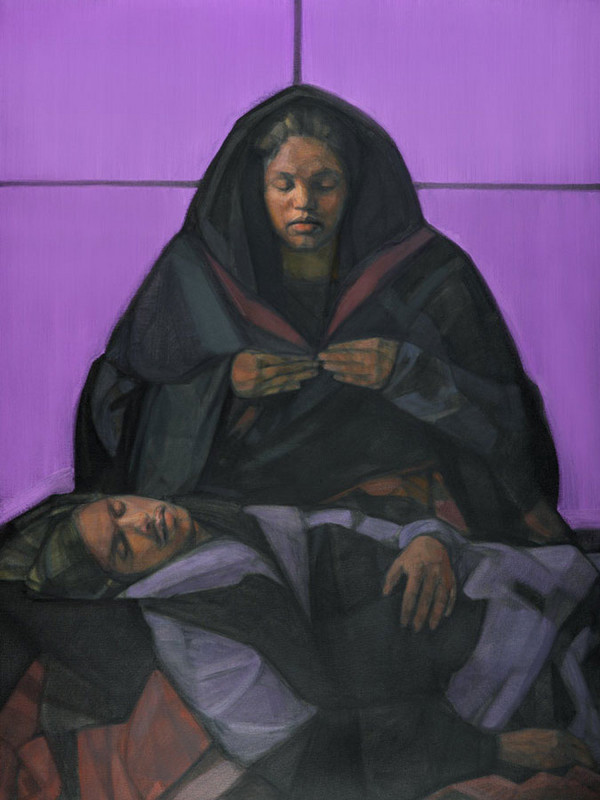
One of the masterworks of my collection is McKenzie’s large format painting, Pieta--the Beloved, depicting the Virgin Mary grieving over her son taken down from the Cross, represented by thin intersecting lines behind her head in a twilight purple background. McKenzie lends this mourning woman of color a quiet dignity, weighted down with grief like her heavy, enveloping black robes. The eyes of the Virgin Mother are closed in prayer. Her hands meet over her heart as she makes the ultimate sacrifice of giving over her beloved son to the world he has died to redeem.
An image of such commanding spiritual presence can never "belong" to one person. I have loaned McKenzie's Pieta to art exhibitions, knowing it should only stay with me until the time comes when it can be hung in the kind of setting the artist also envisions for her innovative and inspirational Jesus of the People--a small chapel in a large urban church in a marginalized community, open for the whole world to see it.
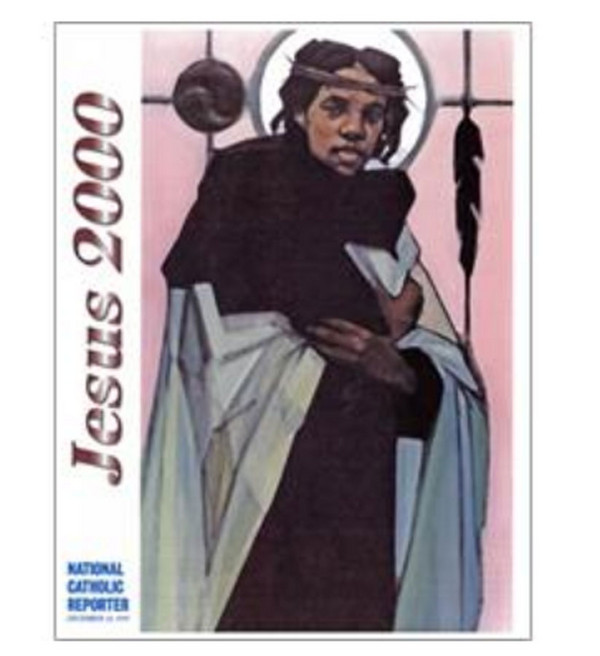
Jesus of the People (cover image)

Jesus of the People at demonstrations
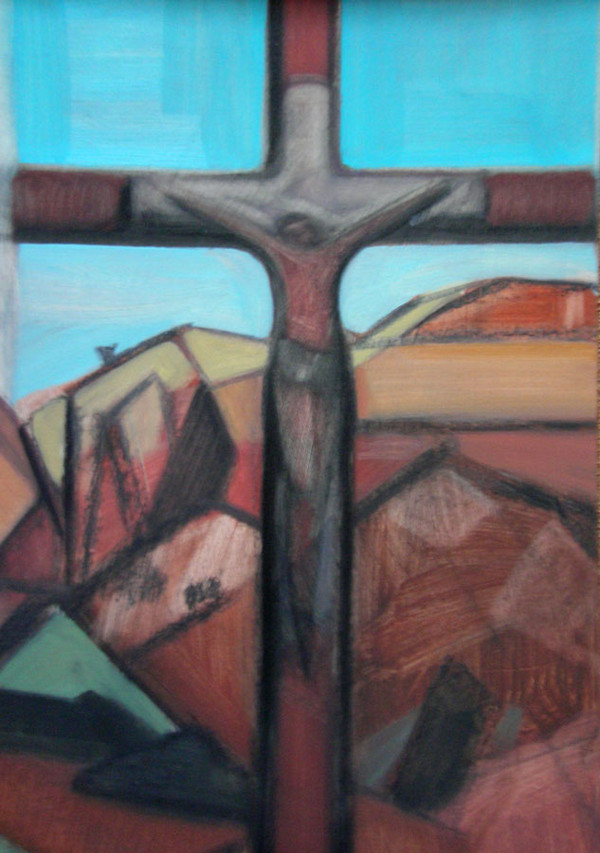
Ghost Ranch, Good Friday
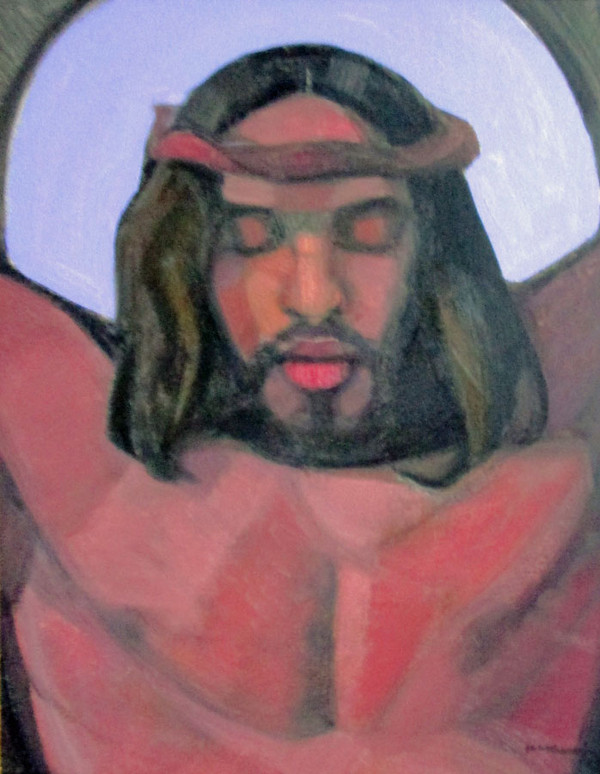
Crucifixion
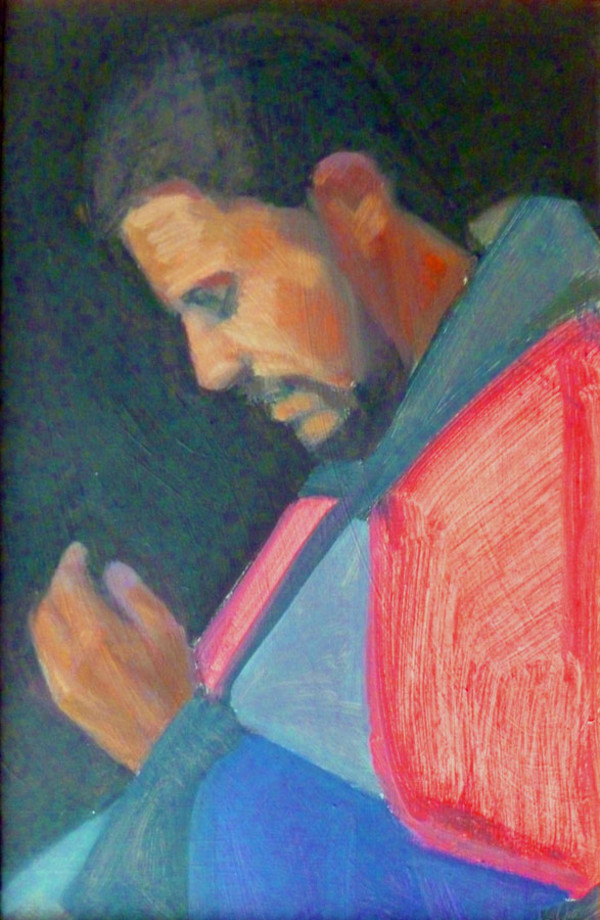
Study#3 fir Jesus at Gethsemane
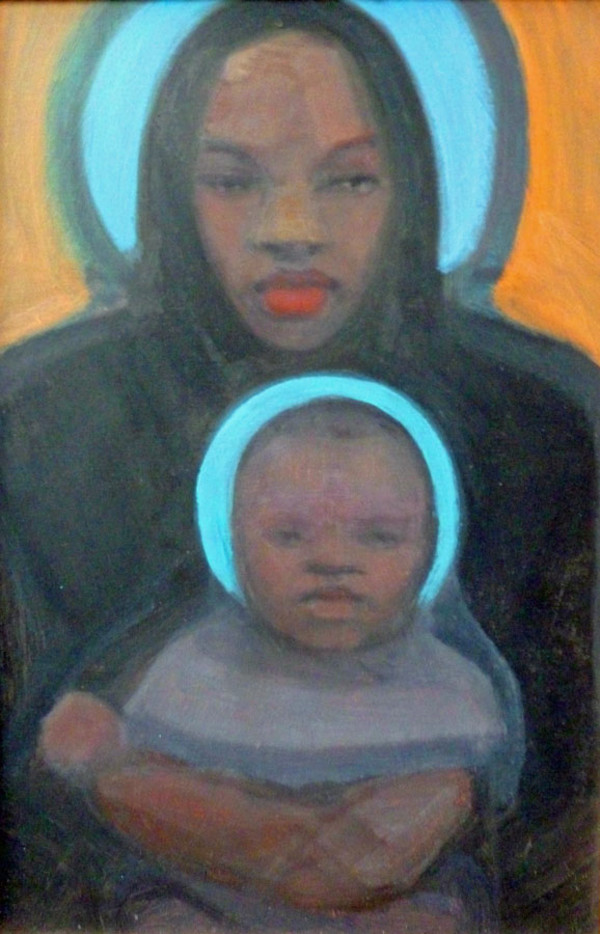
Madonna and Child (with blue halo)
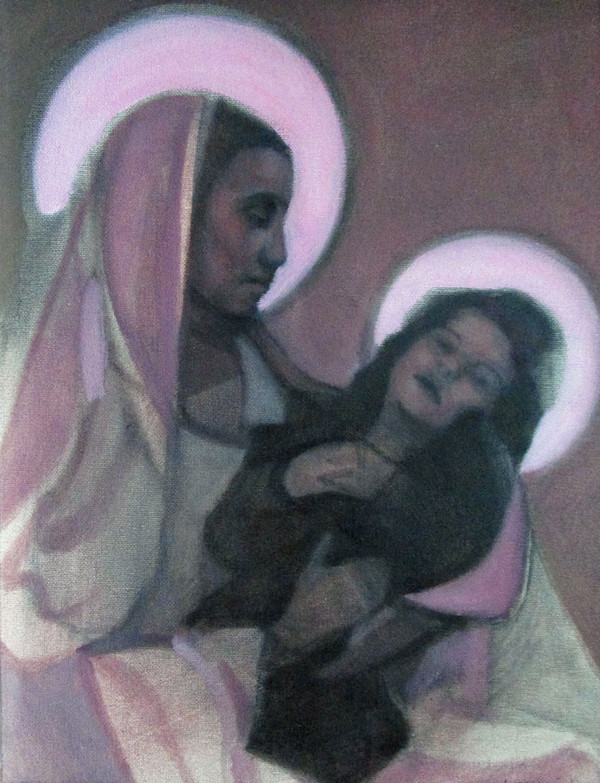
Mary and Her Child, Jesus
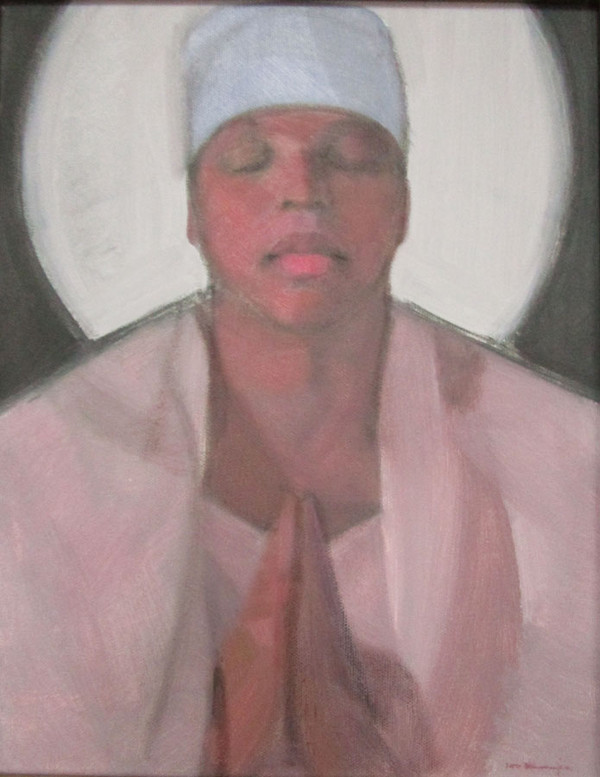
Mary in Prayer
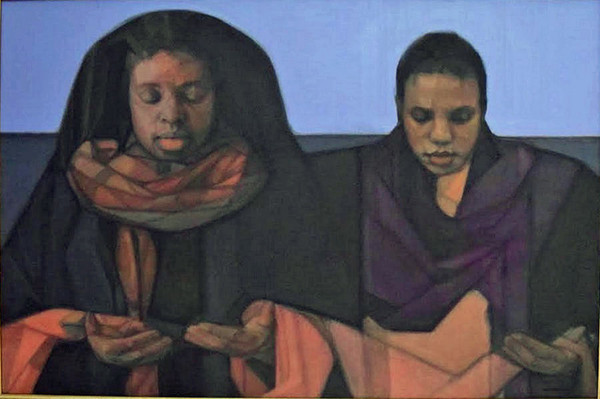
Mary and Elizabeth
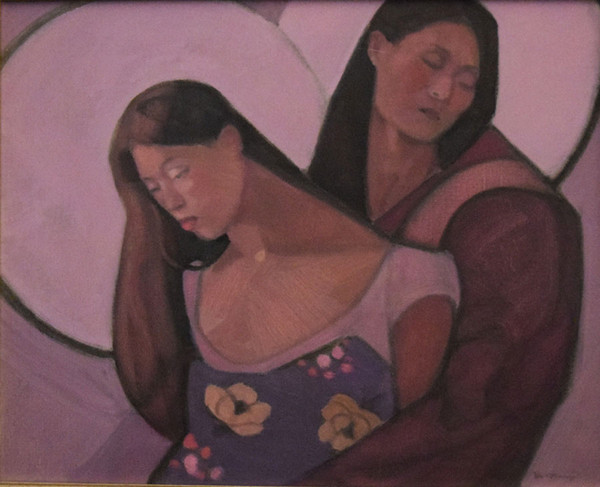
Mary and Elisabeth